
All You Need To Know About Initial Public Offering Or IPO (Part 2 of 5)


( continued … )
IPO Part 2 of 5 : Planning is crucial to a successful IPO.
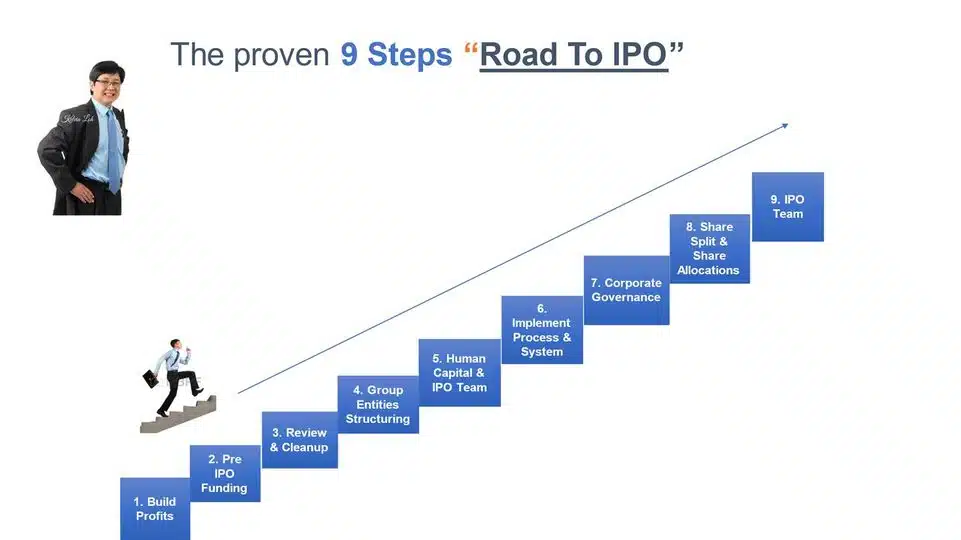
9 advance planning steps:
1. Develop an Impressive Management & Professional team
2. Develop Budget & KPIs
3. Grow the company’s business with an eye to the public marketplace
4. Obtain audited financial statements using IPO-accepted accounting principles
5. Appoint Independent Members to the BOD
6. Clean up the company’s act
7. Build a Positive Public Image
8. Develop good Corporate Governance
9. Develop Long Term Incentive Plan
What’s the first step in an IPO?
1. The firm going public hires an investment bank, or banks, to handle the IPO.
It’s possible for a company to sell shares on its own but, in reality, that never happens.
A company planning an IPO typically appoints a lead manager, known as a bookrunners, to help it arrive at an appropriate price at which the shares should be issued.
2. IPO generally involves 1 or more Investment Bankers known as “Underwriters”.
The company offering its shares, called the “issuer”, enters into a contract with a lead underwriter to sell its shares to the public.
The underwriter then approaches investors with offers to sell those shares.
3. The process of determining an optimal price usually involves the underwriter (“syndicate”) arranging share purchase commitments from leading institutional investors.
That is, Investment banks can work alone or together on one IPO, with one taking the lead.
They usually form a group of banks or investors to spread around the funding—and the risk—for the IPO.
4. Banks submit bids to companies going public on how much money the firm will make in the IPO & what the bank will walk away with.
The process of an investment bank handling an IPO is called underwriting.
5. When an investment bank, like Goldman Sachs or Morgan Stanley is eventually hired, the company and the investment bank talk about how much money they think they will raise from the IPO, the type of securities to be issued, & all the details in the underwriting agreement.
6. What happens next?
After the company & investment bank agree to an underwriting deal, the bank puts together a registration statement to be filed with the SEC or SGX.
This statement has detailed information about the offering & company info such as financial statements, management background, any legal problems, where the money is to be used, & who owns any stock before the company goes public.
7. The SEC / SGX will investigate the company to make sure all the information submitted to it is correct & that all relevant financial data has been disclosed.
8. If everything is OK, the SEC / SGX will work with the company to set a date for the IPO.
9. After SEC / SGX approval for the IPO, the underwriter must put together a prospectus; that is, all financial information on the company that’s doing the IPO.
10. Because of the wide array of legal requirements and because it is an expensive process, IPOs also typically involve one or more law firms with major practices in securities laws.
( look out for IPO Part 3 of 5 )…
If you need help, feel free to contact us at :
(O) +65 63851011
(M) +65 90880669